
By: Matthew Driscoll and Bill Lawler
Live production is no longer confined to a single control room, facility, or fixed set of hardware. Sports, news, entertainment, and event-production teams increasingly operate across IP networks, remote locations, and hybrid environments where traditional broadcast infrastructure intersects with IT-style architectures.
That evolution is creating new possibilities for flexible and distributed production, but it also makes monitoring more complex. Teams must understand not only whether a signal is present or a picture looks correct, but also how media streams, network behavior, synchronization, timing, and redundancy interact across the production environment.
The broadcast industry is adopting the same software-based principles that have reshaped enterprise IT: flexible deployment, centralized visibility, multi-user access, and tools that can adapt as workflows change. Telestream Pulse brings that model to ST 2110 monitoring, combining familiar waveform and signal-analysis tools with timing intelligence, operational dashboards, and role-based visibility in a shared software environment.
Why Traditional Monitoring Has to Evolve
Conventional broadcast monitoring was built around precision instruments and clearly defined physical positions: a waveform monitor in a rack, an engineer at a workstation, and test equipment connected to signals inside a controlled facility. Those tools remain essential, but the environments around them are shifting.
In a distributed ST 2110 production, an engineer troubleshooting an issue may need to consult a waveform monitor, an IP probe, a PTP timing tool, a network dashboard, and an alarm log. Each system provides valuable information, but assembling the complete picture can take time. During a live production, even a few additional minutes spent moving between tools can delay diagnosis and increase operational risk.
Timing adds another layer of complexity. Video, audio, and ancillary data travel as separate flows, and every element must remain synchronized at critical points throughout the workflow. A problem that appears to be a video or audio issue may actually originate in PTP synchronization, network behavior, or ST 2022-7 redundancy. Without a connected view, teams may have to validate multiple systems before identifying the source of the issue.
Software-based IP monitoring provides a more unified approach. Rather than simply adding remote access to tools designed for a fixed facility, it brings signal analysis, timing insight, transport behavior, alarms, and operational status into an environment designed for distributed production from the outset.
Bringing ST 2110 Monitoring into a Shared Environment
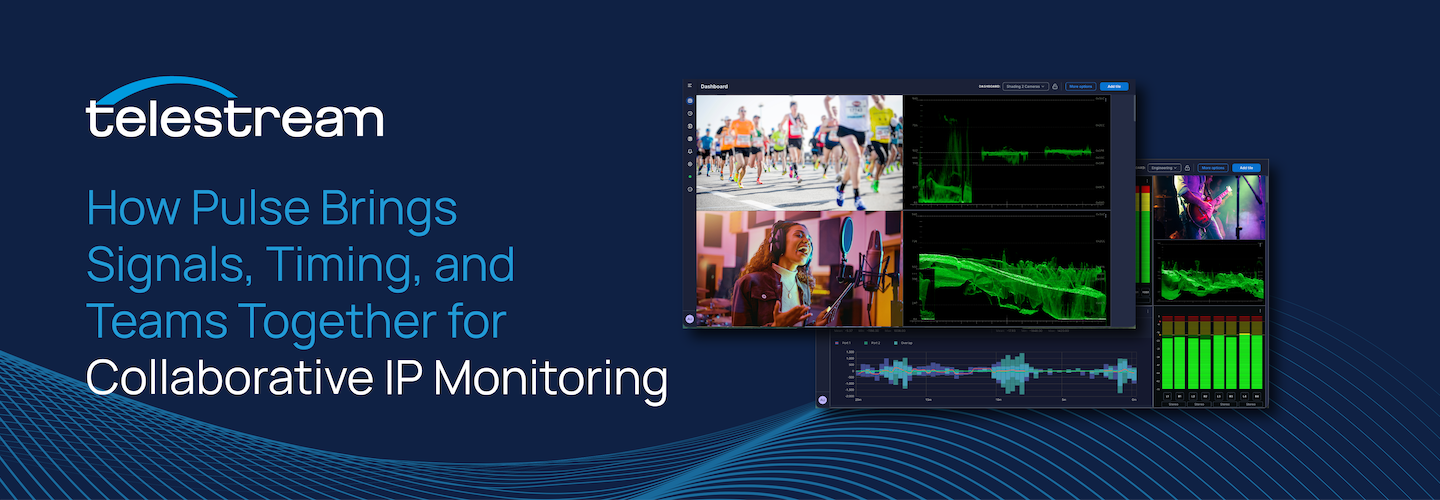
Pulse is designed to give production teams a clearer view of their ST 2110 environment from a common software platform. It combines waveform monitoring and familiar scopes with input-level analysis of ST 2110 video, audio, and ancillary flows. It also provides insight into PTP synchronization, timing offsets, Best Master Clock Algorithm (BMCA) elections, and ST 2022-7 redundancy. Its power is in its ability to connect information that has traditionally lived in separate systems.
When a production issue occurs, an operator may first notice a visible or audible symptom. Pulse gives engineering teams access to the related signal, transport, and timing information within the same monitoring environment, creating a more direct path from symptom to source.
Dashboards, alarms, and event history are designed to help teams understand what is happening across multiple inputs and provide a record of what occurred. That context can reduce time spent reconstructing an incident after the fact and help teams resolve recurring issues more effectively.
Monitoring for Every Role
Modern production is collaborative. Engineers, camera shaders, QC operators, technical directors, and other specialists may need to examine different aspects of the same production simultaneously.
A traditional waveform monitor is often associated with a particular physical position or individual operator. Pulse moves monitoring toward a multi-user model in which authorized users can access a shared environment while maintaining views tailored to their responsibilities.
For a camera shader, that may mean waveform, vector, and picture displays used to evaluate exposure, luminance, and color across multiple sources. An engineer may need deeper analysis of ST 2110 flows, PTP behavior, redundancy, and system status. Operations teams may view dashboards tailored to their specific role or focused on higher-priority signals.
This role-based approach is particularly valuable where technical quality and creative intent intersect. During a sports broadcast, shaders may need to preserve accurate team colors and consistent skin tones as lighting conditions change. An entertainment production may intentionally use heightened contrast or a distinctive color treatment to support the story.
In both cases, teams need objective measurement tools that help them make fast decisions with confidence, without compromising the production’s intended look.
Building Confidence in IP Timing
Accurate timing is fundamental to IP production. When synchronization begins to fail, the symptom may emerge somewhere other than the source of the problem. Audio may appear out of alignment, a video flow may become unstable, or redundant paths may behave unexpectedly.
Pulse brings timing analysis into the same environment as media monitoring. Teams can examine PTP behavior, synchronization, offsets, clock elections, and redundancy alongside the signals themselves. This integrated approach helps engineers determine whether an issue begins with the media, the network, or the timing architecture. It can also help teams validate system behavior before a problem affects the live output.
Pulse makes the right information accessible when it is needed and gives teams greater confidence in the infrastructure supporting the production.
Broadcast Measurement, Delivered Differently
The move toward software-based monitoring does not replace the need for trusted broadcast measurement; it changes how that expertise is delivered.
Pulse builds on Telestream’s experience in waveform monitoring, IP signal analysis, and precision timing, bringing engineering-grade diagnostics into a flexible software architecture. It is designed to support production teams working on premises today while providing a foundation for more remote and cloud-ready monitoring models in the future.
As live-production systems become more dynamic, monitoring can no longer be defined by a single instrument in a fixed location. It must provide shared visibility across signals, infrastructure, and operational roles. Pulse represents that next step: software-defined ST 2110 monitoring that helps teams see many signals, understand timing and system behavior, collaborate across locations, and diagnose issues faster.
To learn more about Telestream Pulse, visit: https://www.telestream.com/pulse/
Heading to IBC 2026? Stop by and see us at stand #21 in Hall 7 or schedule your personal demo of Pulse today. https://pages.telestream.net/ibc-2026