
By: Sebastian Manemann, Sr Director Product Management
In traditional media production environments, teams often relied on proxy files—lower-resolution versions of original media—because working directly with high-res content wasn’t feasible. By creating lightweight versions of high-resolution files, production teams could work efficiently on resource-constrained systems, share content across networks, and accelerate editorial review without moving massive files around.
But today’s landscape is changing. Teams are distributed across locations and time zones. Ultra high-resolution formats—from UHD to 8K—are now the norm. Deadlines are tighter than ever, and the push for faster, more flexible collaboration is forcing a rethink of legacy workflows.
With increased bandwidth, more capable systems, and better compression, many teams are questioning whether they still need to create proxies at all, especially for time-sensitive tasks like review and approval. This shift is driving new interest in proxy-less workflows: delivering mezzanine or high-resolution content directly, without generating a separate proxy file. It’s an approach that aims to reduce friction, accelerate collaboration, and simplify workflows in a distributed production environment.
Benefits and Tradeoffs of Traditional Proxy Workflows
Proxy files were originally used to make media production more manageable—especially in bandwidth-constrained or hardware-limited environments. Editors could work on lightweight versions of content for tasks such as rough cuts or review, without needing access to full-resolution assets.
However, this approach comes with tradeoffs. Generating proxies takes time, often delaying when content becomes usable. It also adds storage overhead by duplicating assets and can introduce sync issues between the proxy and original media. While these limitations were manageable in traditional, centralized facilities, they now create friction in distributed workflows where speed, flexibility, and immediate access are critical.
The Shift to Proxy-less Workflows
The move toward proxy-less workflows reflects a growing need for speed, simplicity, and flexibility in media production. This shift is becoming more feasible due to several key factors.
First, teams are increasingly questioning the value of generating proxies, especially when the goal is quick access rather than mezzanine quality. Second, review and approval workflows don’t always require full-resolution content, just fast access to viewable media. Third, proxy-less strategies reduce operational friction by eliminating delays associated with transcoding and file duplication. And finally, as production teams become more distributed, the ability to access content quickly—without managing multiple versions—has become a necessity rather than a luxury.
While proxy-less review won’t replace every use case for proxies, it offers a streamlined alternative for time-sensitive, collaborative workflows where speed and simplicity matter most.
Where Telestream’s UP.Review Fits In
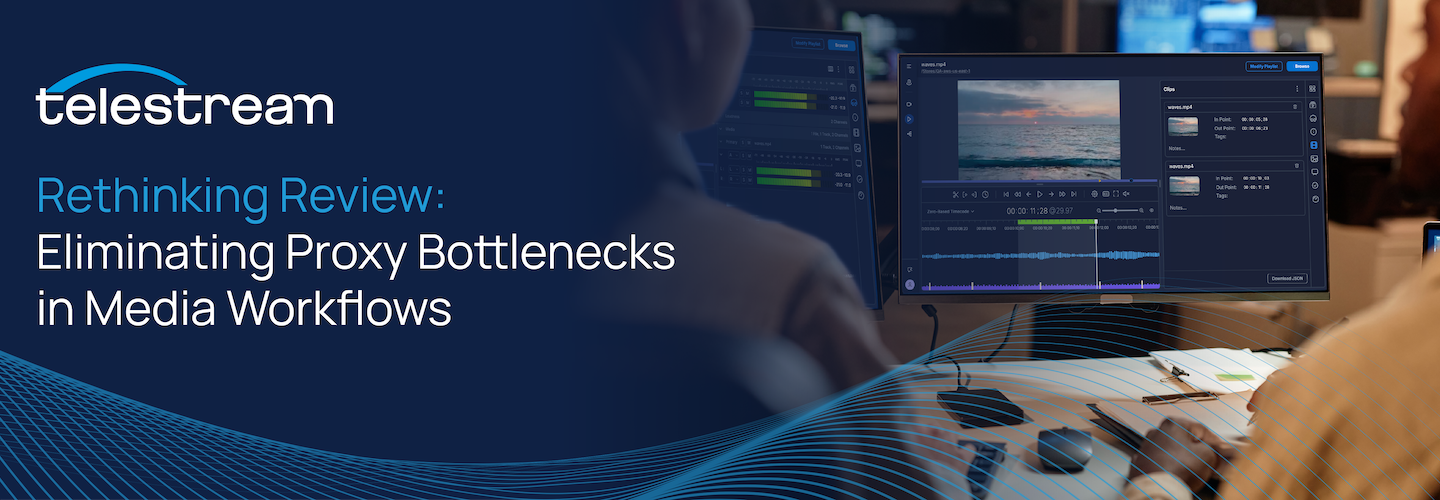
Proxy-less workflows are only effective when paired with tools that support them—tools built not just for Player, but for collaboration. Telestream UP.Review is one such solution. UP.Review isn’t just a player—it’s a browser-based collaboration tool designed for frame-accurate feedback and workflow-integrated approval.
UP.Review acts as a hybrid application built for modern production environments. It streams a just-in-time adaptive bitrate stream directly to users—eliminating the need for pre-generated proxies—while maintaining the precision and performance required for creative decisions. UP.Review also supports frame-accurate commenting, annotations, and approvals, so teams can work from anywhere with confidence that their notes will land exactly where they’re needed.
With lightweight browser access and security controls, UP.Review scales from small editorial teams to global operations. And because it is integrated with workflow automation systems, it can ingest content automatically and notify collaborators when assets are ready for review.
Typical use cases include:
- Reviewing sports highlights in near-real-time.
- Conducting remote quality control before content delivery.
- Managing creative approvals across distributed editorial teams.
- Enabling fast-turnaround edits for newsrooms and live event coverage.
By minimizing friction and eliminating the wait for proxy generation, UP.Review helps teams move faster—without compromising accuracy or collaboration.
Real-World Drivers: Why Proxy-less Review is Preferred
The momentum behind proxy-less playback isn’t just technical—it’s operational. Production teams today are being asked to do more with less: same-day turnarounds, shrinking budgets, and staff spread across global locations. In that environment, every minute and kilobyte matters.
The benefits of going proxy-less are tangible:
- Time savings: No need to transcode or wait for proxy files to be generated before review or approval can begin.
- Faster editorial cycles: Reviewers and stakeholders can access media sooner, accelerating decision-making and content delivery.
- Reduced storage and transfer loads: Eliminating proxies reduces duplication and file movement across systems and teams.
- Streamlined stakeholder access: Review experiences are simplified for executives and collaborators who don’t need editing tools—just a browser and a play button.
In fast-paced environments like news, sports, and digital production, these advantages make proxy-less workflows not just appealing—but necessary.
Evolving Review for Evolving Workflows
Proxy workflows have played a valuable role in media production, but they’re no longer the default. As teams embrace faster turnarounds, leaner infrastructure, and more distributed collaboration, the cost of maintaining traditional proxy pipelines is becoming harder to justify.
Proxy-less review offers a compelling alternative. By eliminating unnecessary steps and enabling direct access to high-quality media, it simplifies production and accelerates decision-making—without compromising creative or technical standards.
Tools like Telestream UP.Review are built for this shift. They support collaborative, frame-accurate feedback without the delays and overhead of proxy creation. For many teams, that means less friction, more flexibility, and faster delivery.
In the end, moving away from proxies isn’t just about skipping a step—it’s about enabling a more efficient and connected creative process.
See Telestream UP.Review at NAB 2026
Telestream will showcase UP.Review Proxy-less Video Player at NAB 2026 (booth W1503). To schedule a meeting, visit https://pages.telestream.net/NAB-2026.
Learn more about UP.Review: https://www.telestream.com/review/