
By: Andrew Scott
In modern broadcast and video production facilities, precision timing isn’t just a best practice; it’s the glue holding the entire infrastructure together. When your network relies on nanosecond-level accuracy, a drifting clock or a spoofed signal could result in costly on-air faults.
To help engineers maintain bulletproof timing, the Telestream SPG9000 includes a powerful diagnostic tool: the Cross-Reference function. Here is a breakdown of how it works and why it is an essential safeguard for your facility.
What Does the SPG9000 Cross-Reference Function Do?
To “cross-reference” data is to check one source of information against another for verification. The SPG9000 Cross-Reference function compares additional time sources against the current time of the active reference source: GNSS, PTP, Genlock, or Internal.
Specifically, measurements are made by comparing the time information and the 1 PPS (pulse per second) signal from each Cross-Reference source against the main time-of-day (MTOD) system clock. Cross-Reference time sources can be any PTP instance operating as a follower (locked to any upstream grandmaster) or the GNSS input signal. Since the SPG9000 has four network ports that could be configured as followers, that means up to five different time sources can be used.
The result is a continuous audit of system timing. By comparing additional time sources against the system clock, the SPG9000 instantly highlights discrepancies. The measurements can be viewed on the web interface and are also available from the HTTP API. You can set custom thresholds for both warning and error levels, ensuring that any drift is caught long before it impacts your on-air operations.
Understanding the Cross-Reference Measurements
The time offset between different sources can be attributed to several factors. There may be different paths from GNSS antennas to their respective receivers. PTP timing is affected by network topology, port speeds, and traffic load. In the extreme case, spoofing of a GNSS signal or a rogue PTP grandmaster using an incorrect TAI time can result in a large time offset that could cause serious problems.
In the following example, the SPG9000 is configured as follows:
PTP 3 is configured as a leader (so it is not available as a Cross-Reference time source), but PTP 4 is configured as a follower to that leader.
- Reference source is GNSS.
- PTP 1 is a follower to a grandmaster on the local network.
- PTP 2 is a follower to another grandmaster over a wide area network.
- PTP 3 is configured as a leader (so it is not available as a Cross-Reference time source), but PTP 4 is configured as a follower to that leader.
Health of the Active Reference Source
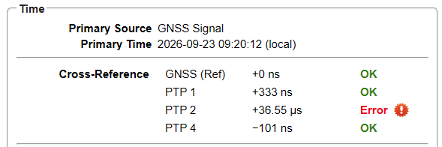
Looking at the Cross-Reference measurements, we can see that the system clock is locked to the GNSS timing, which is expected because the GNSS signal is the active reference source for the system.
But if the GNSS signal is temporarily lost, the SPG9000 would go into holdover mode to maintain the system clock. The internal oscillator keeps the same clock frequency and phase prior to the GNSS signal loss. If the system is in holdover mode for an extended period, it is possible for some clock drift to accumulate. When the GNSS signal is restored, that drift measurement will appear as the Cross-Reference offset between the GNSS source and the system clock. You can then observe the holdover recovery in action, as this difference converges back to zero. Without Cross-Reference, you would have much less visibility into the holdover recovery process.
Timing Adjustments Between Reference Sources
Next, we can see that the PTP 1 follower has about 0.33 microseconds offset from the system clock. Its PTP grandmaster also has a GNSS reference source, but uses a different antenna, different cable, and different receiver from this SPG9000, so a time offset is not a surprise. By using Cross-Reference, we can accurately measure the actual offset between the two systems. The GNSS cable delay offset of the SPG9000 can be adjusted by 0.33 µs to align the two generators. Without Cross-Reference, you may not even be aware of this offset or you may be blind to its actual value. When the system timing of the two generators is closely aligned, a switch from the primary SPG9000 to the backup unit (or back again) should cause no disruption.
Alarm Notifications for Unexpected Time Differences
The Cross-Reference measurement of PTP 2 illustrates the ability of the SPG9000 to assert alarms for offsets that exceed user-configurable thresholds. In this case, the large offset (36.55 µs) causes an Error alarm to be displayed. In addition to this indication on the web interface, errors or warnings are generated as follows:
- On the front panel, the “X-REF” indicator changes color from green to red (error) or yellow (warning).
- Management systems can be alerted via SNMP Trap messages and/or syslog messages.
- A General Purpose Interface (GPI) output can be asserted to signal an external physical tally or alarm system.
Metrics for Network Monitoring and Management
Lastly, the PTP 4 measurement is used as a monitoring point for the leader that is using the PTP 3 port. The SPG9000 has four PTP ports available, but if you are only using two of them for a dual grandmaster (on amber + blue networks), for example, the other two ports would be more useful for PTP monitoring than remaining disabled. If connected to separate switches at the far end of the network from the grandmaster, they would show how PTP is received at the network edge. These monitoring ports simply need to be configured as Follower Only instances, without using them as reference sources.
In this specific instance, there is an offset of about 100 nanoseconds due to the network path between the two interfaces. If this appears to be a relatively constant offset, it can also be negated. Similar to the GNSS cable delay offset described above, PTP followers have a configurable Delay Asymmetry setting. Using Cross-Reference, we can see exactly what this value should be.
Keep Timing in Check with SPG9000 Cross-Reference
By providing real-time visibility into the health of every clock hitting your network, the SPG9000’s Cross-Reference feature takes the guesswork out of facility timing. It transforms a highly complex, invisible metric into clear, actionable data.
To learn more about Telestream SPG9000, visit: https://www.telestream.com/spg9000.