

By: Andrew Scott
For IP-based broadcast and video production applications, Precision Time Protocol (PTP) is used as the timing reference for the facility. It is typically used over dedicated local media networks using PTP-aware networking equipment (such as Boundary Clock or Transparent Clock switches), but it may be surprising to learn that PTP can also operate over general-purpose wide area networks (WANs). The Telestream SPG9000 master clock and sync generator includes several features that enable this mode of operation.
Why Would PTP Over WAN be Needed?
You may wonder why PTP would be used over a wide area network. There are several good reasons:
- Availability: An accurate, traceable, time source like GNSS may not be available at the current location. Perhaps a mobile production truck is parked underneath a stadium without clear access to the sky for signal reception, or it may be difficult or expensive to arrange rooftop access and install a cable conduit to the equipment room in a tall building.
- Trust: A PTP connection over a secure network to a grandmaster in a trusted location may be a safeguard against GNSS signal spoofing or jamming at the production location. The SPG9000 can use this PTP follower either as the primary reference source, as the secondary source when the GNSS signal is lost, or simply as an additional time source for monitoring purposes. The SPG9000’s Cross-Reference feature can serve as a “second opinion” for the GNSS time. Any significant time offset between the system clock and the remote PTP grandmaster could trigger an alarm in the management system.
- Resiliency: A media network distributed across multiple physical locations can be synchronized to a common time base. PTP connections between locations can be used as secondary reference sources in case of loss of the primary reference source for any facility.
How is PTP Over WAN Different?
Recall that PTP works by exchanging packet timestamps between the leader and follower. Timestamps from both received and transmitted PTP messages are used to compute delay measurements for both leader-to-follower and follower-to-leader directions. Delay values can vary according to network conditions but have a minimum value defined by physical characteristics such as cable length and switching time.
Wide area networks typically have a much higher packet delay variation (PDV) than PTP-aware networks. Boundary Clock switches prevent PDV from accumulating at each hop by terminating PTP at the follower port and re-generating PTP for each of its downstream leader ports. Standard network switches do not treat PTP differently than any other packet type.
A typical histogram of packet delay values greater than the minimum delay is shown on the graph below. The distribution is skewed positively because most packets will transit the network slightly above the minimum delay, but some packets may experience high delay because of congestion and other factors.
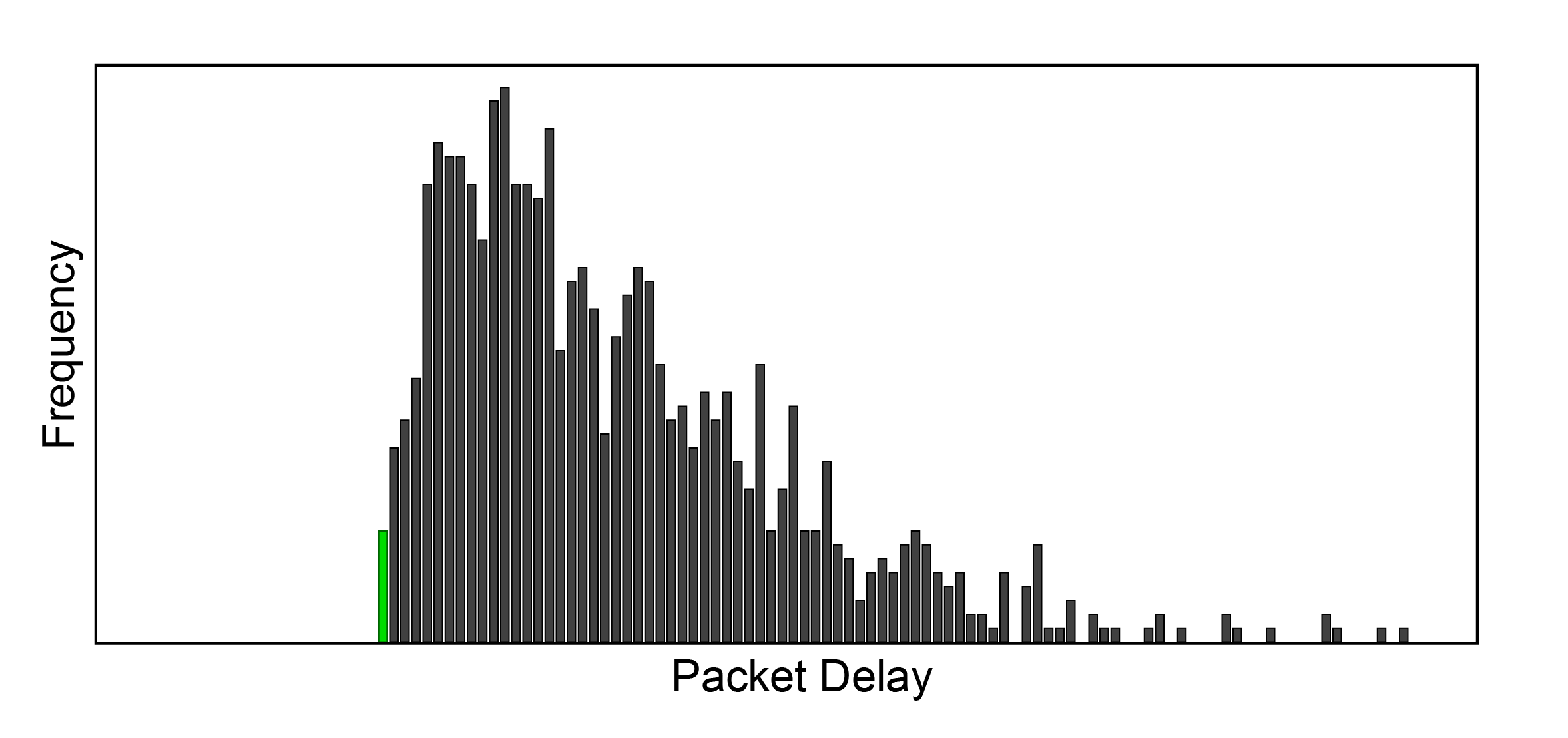
One effective way to mitigate the effects of traffic-induced PDV is to only use the smallest delay values. A timestamp filter can be used to selectively choose only the best values in each sample period and ignore the others. If the rate for Sync and Delay_Request messages can also be increased, a high ratio of raw packet rate to filtered packet rate (e.g. 128:1) will result in the lowest available packet delay values for this network.
Even with timestamp filtering applied, the instantaneous Offset From Master value, calculated as the time difference between the leader clock and the follower clock, may vary over a wide range in a high-PDV network. We would not want the system clock of the SPG9000 to react immediately to these large swings, so a servo loop is used to dampen the rate of change of the clock frequency. The servo loop needs a much higher attenuation for high-PDV networks compared to local Boundary Clock networks.
Configuring PTP Over WAN For the SPG9000
The following process can be used to configure a PTP follower for WAN operation on the SPG9000:
- Use the Unicast communication model. It is likely that multicast messages cannot be used on a general-purpose WAN because of the additional routing protocols that need to be configured. Therefore, a point-to-point connection between the leader and follower is easier to manage. Add the IP addresses of one or more potential leaders to the Unicast Discovery List. The follower will request Announce messages from each possible leader and use the Best Master Clock Algorithm (BMCA) to select the best one.
- Set a higher Sync message rate. In unicast mode, the follower requests a specific message rate from the leader. This is different from normal multicast operation, where the Sync message rate is configured on the leader side. The normal ST 2059 PTP profile defaults to 8 messages per second but allows up to 128 messages per second. A higher message rate will be more effective with the timestamp filter.
- Enable timestamp filtering. Select 1, 2 or 4 messages per second. A lower number results in better delay values (lower PDV) being used for PTP calculations, at the expense of slightly slower lock time.
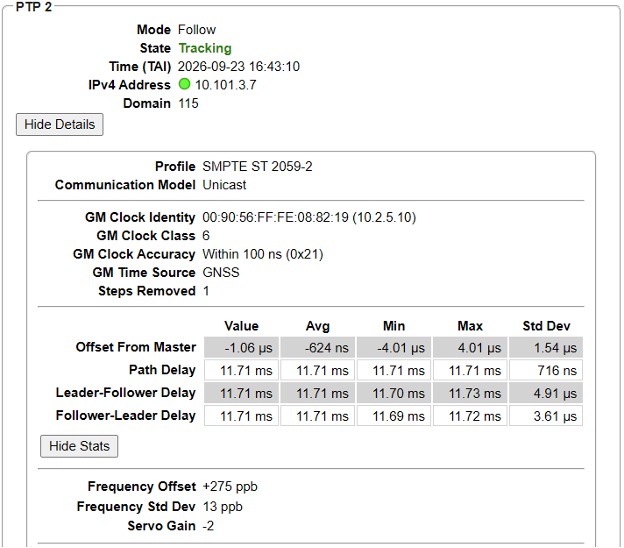
- Observe the Offset From Master measurements. The SPG9000 displays the current Offset From Master value every second and displays several summary statistics (mean, minimum, maximum, standard deviation) that are updated every 32 seconds.
- Set the Tracking Threshold. Check the minimum and maximum measured Offset From Master values to set the Tracking Threshold setting to a value approximately twice the observed difference from zero. The displayed PTP status should change from “Adjusting” to “Stabilizing”.
- Observe the servo loop as the PTP follower locks to the leader. The clock parameters for the PTP follower are also displayed on the web interface. The Frequency Standard Deviation should decrease as the Servo Gain decreases (more attenuation). When the Servo Gain reaches its final value, the PTP status will change from “Stabilizing” to “Tracking”.
Limitations
The performance of PTP over WAN links will greatly depend on the network type and conditions. Networks with occasional internal route changes will cause the delay values to jump, resulting in the SPG9000 temporarily going to holdover mode while the PTP follower re-acquires synchronization. Networks with asymmetry will result in a timing offset between the leader and follower. It is very important to work with the network provider to set up an appropriate link, and to test the operation of the link for extended periods of time before using PTP over WAN for critical operations.
Summary
The SPG9000’s ability to lock to a PTP leader over a wide area network (without the use of Boundary Clock or Transparent Clock switches) enables several options for your media network architecture. PTP can be used as a reference source in environments where GNSS is temporarily or permanently unavailable, it can be used as a cross-reference time source to guard against spoofing attacks, and it can be used to synchronize a distributed media network across separate physical locations.
To learn more about Telestream SPG9000, visit: https://www.telestream.com/spg9000.